October 16, 2013

Kauai Bill 2491 passes

The bill passed in the middle of the night, earlier today after a marathon special council session. The controversy will undoubtedly continue, there may be lawsuits, enforcement issues, and so forth, but at least we should get some information disclosure and perhaps that will enable some clarity and transparency that seems much needed.

The video is quite instructive (I watched the last 45 minutes, see link below) as the long night meeting in the end brought out the very human side of the process. Following 17:55 there is a distinct turning point when the patience of many in the room suddenly runs thin, order is firmly but gently restored by the chair, and from that point there is a momentum to wrap up with thank-you's and move to a vote.

First off what's striking is how gut-wrenchingly emotional this entire process is. I have to say that objectively looking at this bill it requires what appears to be quite routine county oversight of five businesses yet the tone of the room is as if World War Three is hanging in the balance.

Overhanging the whole thing is a county attorney opinion about the bill that the council has chosen not to make public. As a result, there are references in the proceedings to unspecified legal concerns that they are unable to discuss publicly. It's difficult to have useful public debate when there are important concerns held in secret as part of the process. Why these legal issues were not mitigated through the amendment process I have no idea.

Another unfortunate circumstance surrounding the bill is that in theory the state of Hawaii should already have responsibility for this matter but in fact has been doing so little for so many years that the county was forced to take this on itself if anything was to be done at all. Yet for the county to act within the purview of state responsibility appears to require a Memorandum of Understanding. Whether the bill or the MOU comes first seems to be a bit of a chicken-and-egg problem but since the mayor has already started dialog with the state - and was urging delay as those discussions seem to take considerable time. With this bill in the works now for many months I would think a MOU could have been forged long ago, or perhaps an MOU of intent to produce an MOU. Again, this is all part of an opaque process so I won't speculate beyond remarking how clear-as-mud the whole thing is.

With the bill now destined to become county law (the mayor has pledged not to veto it) no doubt the county, the state, and of course the affected big ag companies here will doubtless be having many strategy meetings. By no means does passage mean the Bill 2491 story is over!

Coincidentally in Washington DC it seems that also after a lot of emotion the Congress finally agreed to fund the government and restore federal services that have been shutdown over their wrangling. This may be a week for reconciliation.

More details:

October 14, 2013

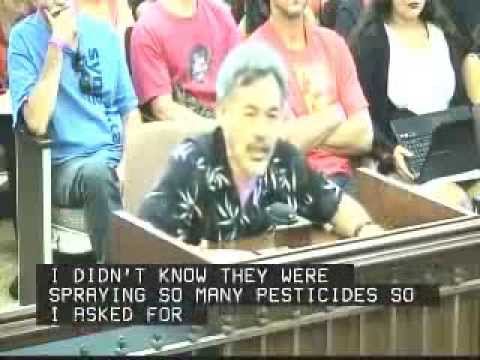
Dr. Pang on GMO in Kaua'i

Today I learned about Dr. Pang, watched his recent testimony on Kaua'i about Bill 2491 and GMO, and found it compelling. While 100% of what he says may not be perfect, this overall message is the best thought out and well reasoned I have yet to seen by far. It's must-see (linked above) if you care about this issue.

Dr. Pang makes a number of excellent points that I won't attempt to condense and summarize here - he is the expert and speaks for himself most capably.

Speaking for myself, not an expert, my key takeaway that I found convincing is his appeal to disclosure: the first thing that we must do is to get the companies doing this work to log and report on their activities. The reasoning is quite straightforward: without solid information it's impossible to do any kind of scientific investigation at all. Only when we have actual data can we begin to look into claims of harm as well as exonerate the same activities from culpability. Absent reliable data, everything remains unclear, nothing can be proven one way or the other. (Again, this just touches on one part of he presentation and following Q&A in the video, but it's such a fundamental point I think it's worth focus.)

He anticipates and counters a number of obvious possible objections, but the bottom line here is even if it is imperfect data, even if the county cannot rigorously enforce accurate and full disclosure, collection of data enables science going forward. We can improve on data quality and quantity, compliance over time but the longer we delay we lose the opportunity to gather data at all in the present. Surely any responsible business already has all of this data and more internally. To the degree details are confidential the county should be trustworthy to keep it private, or only publish digests to interested parties such as researchers that would not reveal proprietary business intelligence inappropriately. Providing data about operations to the county cannot be a major expense at the scale these companies operate, nor is it at all a threat to their business.

Also the analogy Dr. Pang draws to sugar cane burning oversight on Maui seemed relevant and promising. Companies are obliged to log and report whenever they plan to burn cane fields, an essential part of the growing cycle for sugar cane. They provide the county details such as location, area, wind conditions before and after, and so forth. The county in turn can not establish buffer zones or warn citizens as appropriate given the information. Relating this back to GMO and Bill 2491, Dr. Pang aptly noted that ideally the county should get disclosure first and based on that information it could better set effective buffer zones rather than pre-establish buffers in the bill itself; however, he concurred that if the situation was deemed urgent then early setting of buffers arbitrarily was reasonable.

Additionally, Dr. Pang recommended (which Bill 2491 does not do) getting disclosure of the specific GMO mutations being released into the environment. This makes good sense as basic data gathering practice. There was confusion in Q&A, but I believe what this means is disclosure of the type of GMO product (for example, in the case of corn, is it herbicide-resistant or insecticide-producing).

We will see if touching on this topic leads to vociferous responses in the comments: I welcome input so long as it is respectful and backed by evidence cited (see below for my part; naturally, Dr. Pang backs up his statements with citations himself). Should anyone reading this disagree with my takeaway, I would invite them to comment, and only ask for a specific response ("disclosure" below means per Sec. 22-22.4 of Kauai County Bill 2491). Here are a few points I would like to see anybody's best rebuttal:

  1. How would reasonable disclosure make the situation significantly worse?
  2. If required disclosure is onerous to business, exactly how, and what are the major costs and impacts incurred?
  3. Without real data from required disclosure, how can government or independent researchers possibly study the impact of GMO on west Kaua'i communities at all?

Background info:


June 4, 2013

Kauaʻi by the Numbers

This island is a microcosm in many ways, small but not tiny. The following statistics are intended to convey a sense the actual scale of the island.

Kauaʻi is a county (the privately owned Niʻihau included) within the state of Hawaii. At the library I found a report that provides a lot of statistics that paint a clear if sometimes surprising picture of this place. Here are some excepts from the 2010 data in the report.

The island of Kauaʻi is 552.3 square miles, with 113 miles of coastline, the fourth largest island in the state. Niʻihau is 69.5 square miles with 90 miles of coastline, twenty miles away.

The population in 2010 census is 67,000, with on average nearly 20,000 visitors (tourists) on island. Nearly one millions visitors arrive per year

Of the resident population, haole (whites) are the dominant ethnic group at 32%, followed by Hawaiian/Polynesian at 20%, Filipino 19%, Japanese 18%, and others for the remaining 11%.

Just over 1% of the population here is homeless, excluding the so-called "hidden homeless" (living with family or friends).

Broadband Internet access (as of 2010) was 59% with 83% having home access. Access is lowest among the older (65 and older) and in the west (where I am staying now).

Electricity here is, I believe, the most expensive in the nation at over $0.40/kWh. The electricity I am consuming is generated at Port Allen by KIUC from burning oil shipped from the mainland by tanker.

Source: "Measuring What Matters for Kauaʻi" [Part I and Part II] by the Kauaʻi Planning & Action Alliance